

What Wedding Extras Don’t Matter (But Your DJ Absolutely Does)
What Wedding Extras Don’t Matter is a question many UK couples ask while planning their big day. With so many optional upgrades, add-ons and “must-haves” promoted by wedding suppliers, it can be difficult to know which extras are worth your budget and which you can confidently skip.
This guide cuts through the marketing hype with honest, practical advice to help you spend your wedding budget wisely. We’ll explore which extras are often unnecessary, where your money will have the biggest impact, and how to focus on the details your guests will genuinely remember.
Here’s the truth most suppliers won’t tell you: many wedding extras don’t actually matter to your guests, and some are forgotten within minutes of the reception starting. What guests remember instead is far simpler. The atmosphere. The energy. The feeling of being properly looked after all night.
That’s precisely where your wedding DJ becomes one of the most important investments you’ll make, even while dozens of smaller extras quietly fade into the background. Let’s break it down properly, so you can save money where it genuinely won’t be missed, without sacrificing what actually makes your day unforgettable.
The Skip List: Wedding Extras That Genuinely Don’t Matter
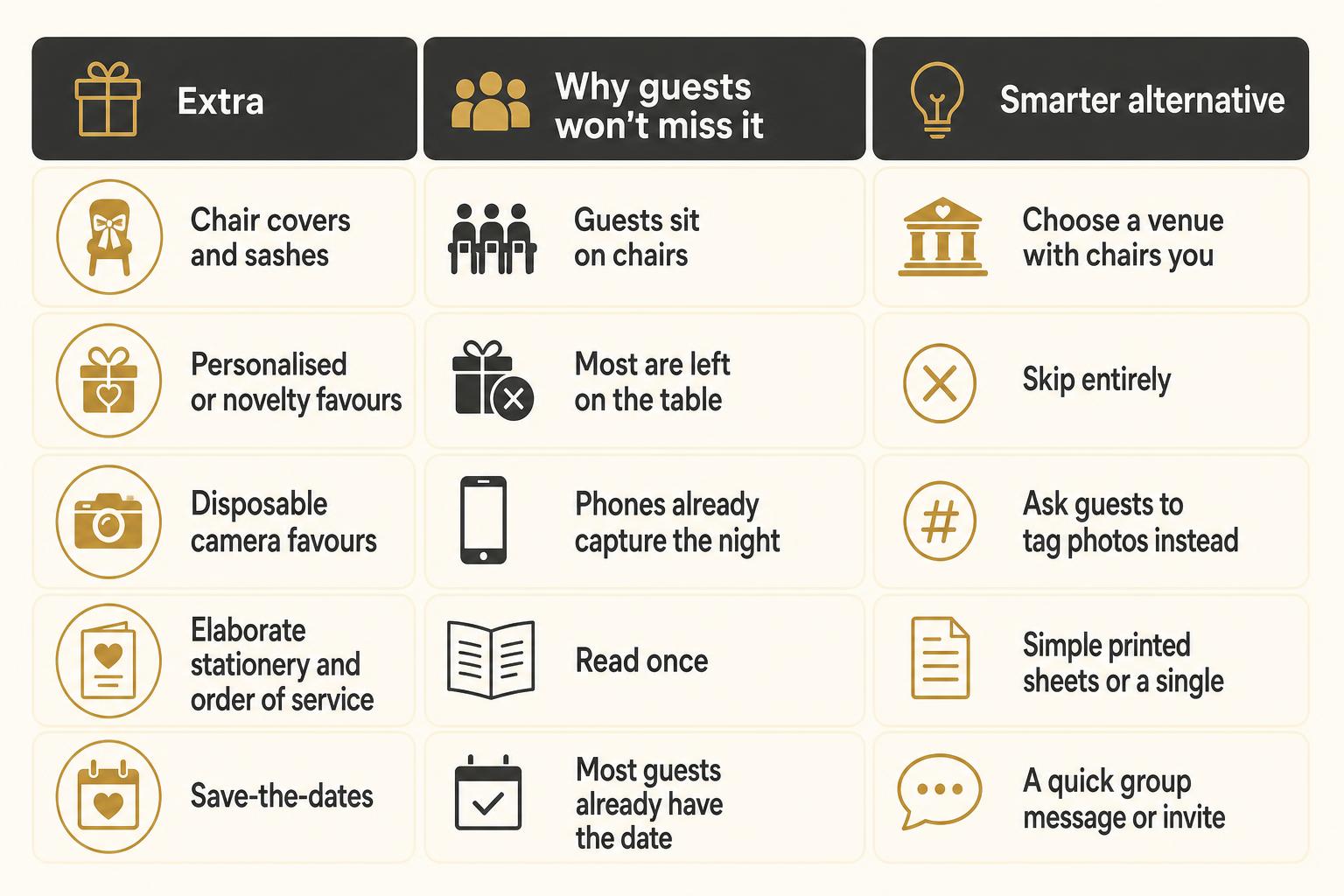
Forums, wedding planners and thousands of real UK couples keep naming the same culprits. None of these will ruin your day if you leave them out, and most guests won’t even notice they’re gone.
| Extra | Why guests won’t miss it | Smarter alternative |
|---|---|---|
| Chair covers and sashes | Guests sit on chairs, they don’t inspect them | Choose a venue with chairs you already like |
| Personalised or novelty favours | Most are left on the table at the end of the night | Skip entirely, or offer something edible |
| Disposable camera favours | Phones already capture the night in better quality | Ask guests to tag photos instead |
| Elaborate stationery and order of service booklets | Read once, then left on a chair | Simple printed sheets or a single sign |
| Save-the-dates | Most guests already have the date in their diary | A quick group message or invite works fine |
| Fireworks displays | Costly, weather-dependent, and over in minutes | Sparklers or a well-timed final song instead |
| Food walls and elaborate grazing displays | Impressive for photos, barely touched by guests | A simple, generous evening buffet |
| Upgraded chairs (Chiavari and similar) | Rarely photographed, quickly forgotten | Spend the hire fee on lighting instead |
| Aisle runners and floral arches | Guests are watching you, not the floor | Simple, elegant ceremony décor |
| Extensive florals beyond the bridal party | Removed or binned once the evening starts | Minimal, stylish centrepieces |
| Printed place cards | A single seating chart does the same job | One clear board near the entrance |
| Champagne toasts for every guest | Many guests don’t drink it or don’t finish it | Offer it as an optional extra, not a default |
None of that means these things are wrong to have. If chair sashes genuinely make you happy, keep them. The point isn’t that they’re bad choices, it’s that they rarely change how your guests experience the day, so they shouldn’t come before the things that do.
Give Yourself Permission to Skip Tradition
It’s completely normal to feel guilty about cutting things “everyone else” seems to have. However, wedding planning has quietly shifted. Couples in 2026 are far more comfortable saying no to traditions that don’t mean anything to them personally, and skipping extras is no longer seen as settling for less.
Your guests are there to celebrate your marriage, not to judge your centrepieces. Nobody leaves a wedding talking about the stationery. They leave talking about how much fun they had, whether the food was good, and whether the dance floor was rammed from the first song to the last. Once you accept that, the whole planning process gets a lot lighter.
A simple rule works well here: skip what you personally don’t care about, and spend confidently on what you do. That’s the entire philosophy behind this article, and it applies to your budget as much as your Pinterest board.
The Guest List Is Your Biggest Budget Lever
Before you agonise over favours or signage, look at your guest count. It’s repeatedly cited as the single biggest lever any couple has over their total spend, because almost every other cost, catering, drinks, favours, stationery, scales per head.
UK weddings currently average somewhere in the region of £21,000 to £22,000 in total, with cost per guest sitting around £272 to £278 in 2026, up from roughly £261 in 2024, according to UK average wedding cost data. Do the maths on your own guest list and the numbers move quickly. Cutting twenty guests from your list can save more than any single extra you’d otherwise be tempted to skip.
| UK wedding cost snapshot | Approximate figure |
|---|---|
| Average total UK wedding cost (2026) | Around £21,000 to £22,000 |
| Average cost per guest (2026) | Around £272 to £278 |
| Average cost per guest (2024) | Around £261 |
| Recommended contingency fund | Around 10% of total budget |
Venue and catering remain the categories worth protecting, since they typically account for more than half of the average wedding budget between them. If money is tight, that’s where careful research pays off, not in trimming favours you were probably going to skip anyway.
The Hidden Extras That Actually Blow the Budget
Interestingly, it’s rarely one big item that pushes couples over budget. It’s a string of smaller, easy-to-forget costs that stack up quietly in the background. These include corkage fees, supplier meals (typically £25 to £40 per supplier), cake-cutting charges, postbox or card table hire, tips, and stationery postage.
None of these sound dramatic on their own. Add them together across a dozen suppliers and a hundred and fifty invitations, though, and they can easily outweigh a single “big” extra you spent weeks worrying about. Building in a contingency fund of around 10% on top of your planned budget is a sensible habit, precisely because these smaller costs are the ones that actually catch couples out.
UK Regional Wedding Cost Differences
Where you marry and when you marry both move the numbers considerably. Scotland tends to see the highest average spend per head of any UK nation, while London carries its own well-known premium on venues and suppliers. Meanwhile, the day of the week matters just as much as the postcode.
A Saturday wedding is consistently the most expensive day to book, purely down to demand. A Tuesday wedding, by contrast, is typically the cheapest, with many suppliers and venues offering meaningfully lower rates. If you’re genuinely open to a weekday date, our guide to weekday wedding savings in the UK breaks down exactly how much that can save across DJ costs, venue hire and registrar fees.
Decorative Extras vs Entertainment Extras: The Difference That Matters
Here’s the distinction most wedding blogs miss entirely. Not all extras are equal, and lumping your DJ in with chair sashes and favours is where a lot of couples go wrong.
Decorative extras are vanity spend. They exist to look good in photographs for a few seconds, and once the moment passes, they add nothing further to how your guests feel. Entertainment extras work completely differently. Your DJ, your lighting, your dance floor atmosphere, these run for hours, touch every single guest in the room, and directly shape whether people remember your wedding as brilliant or merely fine.
Industry data for 2026 shows couples increasingly trimming guest numbers while spending more per attendee on experience, essentially trading quantity for quality. That’s not a coincidence. Fewer guests, spent on better entertainment, consistently produces a more memorable night than a huge guest list propped up with a Bluetooth speaker.
Why Your Wedding DJ Is Never on the Skip List
While most extras fade into the background, your DJ sits at the centre of your entire reception. A good one doesn’t just play music, they control the flow, the energy, and the emotional highs of your whole evening.
Your DJ Creates the Atmosphere
Think about the best wedding you’ve ever attended. Chances are, what you remember most is a packed dance floor, songs everyone sang along to, and an energy that never seemed to dip. That doesn’t happen by accident. A professional wedding DJ reads the room, adjusts the music in real time, and keeps momentum building rather than letting it stall.
Your DJ Affects Every Single Guest
Unlike décor or favours, your DJ impacts everyone in the building, from your first dance right through to the final song. A great DJ can bring different generations together on the same dance floor, fill it quickly after quieter moments, and recover the vibe the second energy starts to drop. A poor one, or a DIY playlist left to run itself, can do exactly the opposite.
A Playlist Can’t Read the Room
Spotify might feel like an easy way to save money, but a playlist can’t adapt to the crowd in front of it, can’t mix songs smoothly, and definitely can’t handle a last-minute request or announcement. Weddings are dynamic, and the mood in that room changes constantly throughout the evening, as we cover in more detail in Wedding DJ or Spotify Playlist? Pros, Costs & What Couples Regret Most. Only a skilled wedding DJ can respond to that in real time.
Your DJ Is Your Evening Host
Beyond the music, your DJ often becomes your informal host for the night. They announce key moments, coordinate handovers with your caterers and venue staff, and keep the whole evening running smoothly so you don’t have to think about the schedule at all. If you’d like to see exactly how that timing works across a full wedding day, our Wedding Timeline UK guide lays it out step by step.
Where Smart Couples Are Spending in 2026
Rather than spending on things that look good for a few photos, couples are being far more intentional. Entertainment, guest experience, and atmosphere now sit near the top of most budgets, ahead of vanity extras that were once considered essential.
If you’re building your budget and music plans early, it’s worth working from a proper timeline rather than tackling everything at once. Our 12 Month Wedding Music Planning Checklist is a genuinely practical starting point, covering exactly when to book, confirm and finalise your entertainment so nothing gets left to the last minute.
The Real Cost of Cutting the Wrong Corner
Cutting your DJ budget to save a few hundred pounds can feel sensible on paper. In practice, it’s one of the most common regrets couples raise after the day itself. An empty dance floor, awkward transitions between songs, guests drifting off early, these are the moments people actually remember, not the signage and not the favours. The feeling of the room is what stays with people, for better or worse.
How to Balance Your Wedding Budget Properly
A simple rule keeps most of this in check: spend on experience, save on extras. Prioritise your DJ, your entertainment, and your lighting and atmosphere, since these shape how every guest feels for the entire evening. Save on favours, over-the-top décor, and non-essential upgrades that get admired for a few seconds and then forgotten.
This approach ensures your wedding feels incredible on the night, not just good in the photos afterwards. Combine it with a weekday date if you’re flexible, and a realistic 10% contingency for the hidden extras mentioned earlier, and you’ve got a genuinely solid budget framework for 2026.
Frequently Asked Questions
What wedding extras don’t matter most in 2026?
Favours, elaborate signage, chair sashes, aisle runners, printed place cards and extensive florals beyond the bridal party are the extras most consistently named as unnecessary by real couples and wedding planners. None of them meaningfully change how guests experience the day.
Do guests really not notice wedding favours?
Most favours are left on the table by the end of the night, especially personalised or novelty items. Guests appreciate the gesture in the moment, but it rarely affects how they remember the wedding overall.
Is it okay to skip wedding favours entirely?
Yes. Plenty of couples now skip favours completely, or replace them with something edible that gets eaten there and then rather than taken home and forgotten.
What’s the single biggest way to cut a UK wedding budget?
Reducing your guest count. Nearly every other cost scales per head, so trimming your guest list has a far bigger impact than cutting any individual extra.
What hidden wedding costs catch couples out most?
Corkage fees, supplier meals, cake-cutting charges, postbox or card table hire, tips, and stationery postage. These smaller costs add up quietly and are the reason most couples go over budget, rather than any single large item.
Should we cut our DJ budget to save money?
We’d genuinely advise against it. Your DJ affects every guest for the entire evening, unlike most decorative extras, and a poor booking is one of the most commonly regretted cuts couples make.
Is a weekday wedding really cheaper than a Saturday?
Generally, yes. Saturday remains the most expensive day to marry due to demand, while a Tuesday wedding typically comes with noticeably lower supplier and venue rates.
Do UK wedding costs vary by region?
Yes. Scotland tends to see the highest average spend per guest, and London carries its own well-known premium on venues and suppliers compared with much of the rest of the country.
What’s the difference between a decorative extra and an entertainment extra?
Decorative extras, like signage or florals, are noticed for a few seconds and then forgotten. Entertainment extras, like your DJ and lighting, run for hours and directly shape how every guest feels throughout the night.
How much contingency should we build into our wedding budget?
Around 10% on top of your planned total is a commonly recommended buffer, mainly to absorb the smaller hidden extras rather than any single large surprise.
Why Trust Our Wedding Budget Advice
We’ve been trading as Select Mobile Disco Hire for 25 years, which means we’ve watched wedding trends come and go, seen which extras genuinely lift a reception, and seen which ones quietly get forgotten by the following morning. That experience shapes every recommendation in this guide. We’re not guessing which extras don’t matter, we’ve watched it play out on dance floors for a quarter of a century.
Cut the extras that don’t matter. Invest in what does. Get your Instant Online Quote today to check availability and start planning a wedding your guests will genuinely talk about for years.
Related articles
- Your Wedding DJ Client Portal: A Complete Guide for Booked Couples
- Wedding Band vs DJ Cost Comparison UK: Which Wins for Your Reception?

Get your DJ quote!
Customer Testimonials
Jules did a fantastic job at our friend’s birthday party. Jules accommodated all of our requests without any issues and was very prompt in communicating with us.
SAM E.Fantastic DJ, Lovely personality and got the whole wedding dancing. Took every care for bride and grooms needs and would 100% recommend. Thank you making our wedding night special.
JESSICA & ASHLEY W.Jules was absolutely fantastic, and very dedicated and played great music with all songs requested. I would recommend to anybody and thank you Jules for making our day amazing.
ALICE B.