

If you’re weighing up a wedding band vs DJ cost comparison for your UK reception, here’s the honest answer straight away. A wedding band in the UK typically costs between £1,500 and £5,000 or more, while a professional mobile DJ typically costs between £350 and £1,200, so DJs win comfortably on price. Bands can edge ahead on live performance energy for a specific style of night, but for most couples, most budgets and most reception timelines, a DJ delivers better value, more variety and fewer moving parts.
That’s the quick verdict. Now let’s break it down properly, because cost alone shouldn’t make this decision for you. We’ve compared bands and DJs across six factors that actually affect your reception: cost, music variety, dancefloor energy, reception flow, space and logistics, and reliability. That said, there’s no agency bias here. We’re a DJ company, but we’ll tell you honestly where a band might genuinely suit you better.
Wedding Band vs DJ Cost Comparison UK: The Real Numbers
Cost is usually the first question every couple asks, and it’s the easiest factor to compare fairly. A live wedding band, even a smaller four- or five-piece function band, comes with more people to pay, more equipment to transport and more rehearsal time built into the price. A DJ, by contrast, is one skilled professional with one van of equipment and a much smaller overhead.
As a result, the price gap between the two is significant, not marginal. A mid-range UK wedding band will often cost two to four times more than a mid-range mobile DJ for the same number of hours. If you want a detailed regional breakdown, our guide to DJ hire cost across the UK covers exactly what affects DJ pricing in 2026, from location to hours booked.
Why the Price Gap Is So Wide
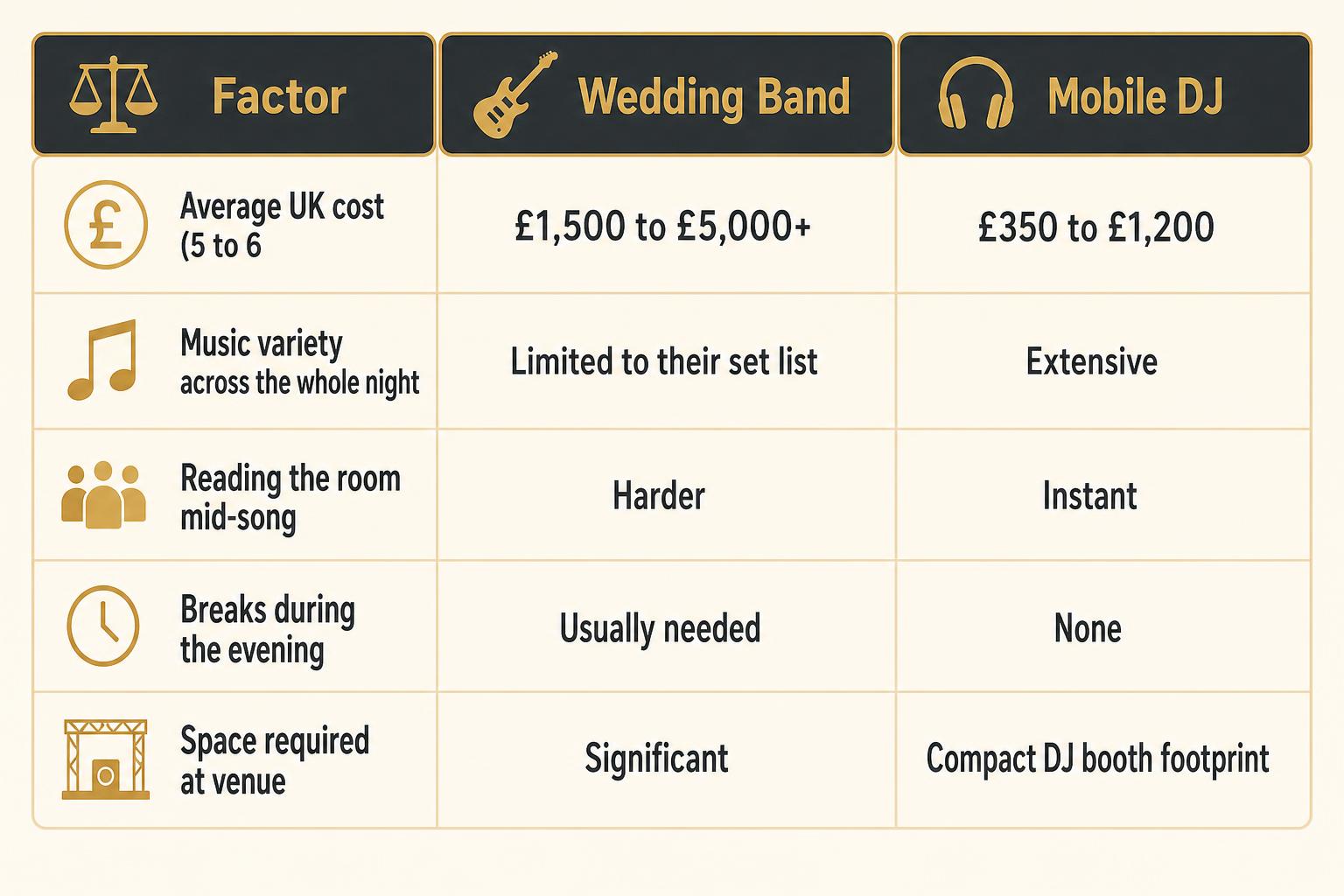
Think about what you’re actually paying for. A five-piece band means five fees, five sets of travel costs and often a separate sound engineer. Meanwhile, a DJ handles performance, sound engineering and music selection as one single fee. Neither model is wrong, but the maths behind them is very different, and that’s reflected honestly in the table below.
| Factor | Wedding Band | Mobile DJ |
|---|---|---|
| Average UK cost (5 to 6 hours) | £1,500 to £5,000+ | £350 to £1,200 |
| Music variety across the whole night | Limited to their set list and genre strengths | Extensive, covers every era and genre on request |
| Reading the room mid-song | Harder, songs are largely pre-rehearsed | Instant, tracks can be changed in seconds |
| Breaks during the evening | Usually needed, often filled by a playlist | None, continuous music all night |
| Space required at venue | Significant, stage and power for the full band | Compact DJ booth footprint |
| Setup and soundcheck time | Longer, multiple instruments to line check | Shorter, streamlined setup |
| Backup if someone is ill | Depends on the agency’s depping arrangements | Straightforward single professional cover |
| Managing announcements and timeline | Sometimes, varies by band | Standard part of the DJ’s role |
Music Variety: Who Plays What You Actually Want?
This is where the gap between bands and DJs really opens up. A band, however talented, has a set list. They rehearse a defined range of songs, usually covers weighted toward their own genre strengths, whether that’s soul, indie or classic party anthems. For example, if your guest list spans grandparents who want Sinatra, cousins who want garage classics and a dancefloor full of teenagers who want current chart hits, one band simply cannot cover all of that convincingly.
A DJ, on the other hand, carries a music library running into tens of thousands of tracks and can pivot instantly between decades and genres. We don’t just play music, we curate it in real time based on who’s actually on the dancefloor at that moment. That flexibility matters more than people expect, especially at multi-generational weddings where musical taste varies wildly across the room.
If you’re weighing this up against simply building your own playlist, our piece on Spotify playlists versus a DJ covers a similar variety problem from a different angle and is worth a read before you decide.
Dancefloor Energy: Live Performance vs Read the Room
Bands bring genuine spectacle. There’s something undeniably exciting about a live horn section or a lead singer working the crowd. For couples who grew up going to gigs, or who simply love the theatre of a live show, a band can create a memorable atmosphere that a DJ setup doesn’t quite replicate.
However, energy on paper doesn’t always translate to a packed dancefloor all night long. Bands are locked into a set list they’ve rehearsed, so if the room isn’t responding, options to adapt mid-song are limited. A skilled DJ reads the crowd continuously, dropping a track early if it’s not landing, extending one that’s working, and blending songs together so there are no awkward gaps between them. That’s where your DJ plays a much bigger role than most people realise, quietly managing energy levels through subtle transitions rather than relying on one fixed show.
The Break Problem
Most bands need rest breaks, typically 15 to 20 minutes between sets. During those gaps, a laptop playlist or a house DJ usually fills in, and energy noticeably dips. A DJ, meanwhile, runs continuously from first song to last, so momentum never resets.
Reception Flow: Who Manages Your Whole Evening?
Your reception isn’t just dancing. It’s speeches, the cake cut, the first dance, the bouquet toss and dozens of small timing decisions strung together across an evening. Someone needs to hold that structure together, making announcements, cueing key moments and keeping things moving without feeling rushed or awkward.
Bands can do some of this, but their focus is understandably on performing their set, not running your timeline. In addition, a dedicated wedding DJ typically takes on the role of informal MC, coordinating with your venue, your photographer and your suppliers so everything happens at the right moment. We cover exactly how much this behind the scenes role matters in our article on why your DJ matters more than couples expect for a genuinely stress-free reception.
Space and Logistics: What Your Venue Can Actually Handle
Practicalities matter more than most couples budget for. A full band needs a stage or a defined performance area, adequate power for amplifiers and instruments, and enough space that guests aren’t crammed against the speakers. Marquees, barns and smaller function rooms can struggle to accommodate a six-piece band comfortably alongside a full dancefloor.
A DJ setup, meanwhile, needs a fraction of the space. Most DJ booths fit into a corner, leaving far more room for guests to actually dance. Setup and breakdown are quicker too, which matters if your venue has a tight changeover window between the wedding breakfast and evening party. If your venue has any noise limiters or restricted access, it’s always worth checking those details early, and our guide covering choosing your perfect wedding DJ includes a checklist of exactly what to ask.
Sound Limiters and Rural Venues
Many rural UK wedding venues, particularly converted barns, have sound limiters that cut power if volume exceeds a set threshold, and it’s worth reading the sound limiter guidance for wedding venues published by the Events Industry Forum if you want the fuller industry picture. Similarly, a full live band, with drums and amplified instruments, can trip these limiters far more easily than a DJ setup, which can be adjusted precisely to stay compliant without losing atmosphere.
Reliability: What Happens If Something Goes Wrong?
Reliability rarely gets discussed until something goes wrong, and by then it’s too late to fix. With a band, more people means more potential points of failure: illness, transport delays, or an instrument issue on the day. Good agencies have depping systems in place, but a substitute musician joining last minute isn’t always a seamless swap for the sound you booked.
A DJ is a single, self-contained professional, which simplifies things considerably. Reputable DJ companies carry backup equipment, hold public liability insurance and have contingency plans for illness. We’ve written in detail about the legal side of this in our article on PLI and PAT compliance for UK mobile DJs, which is worth checking whoever you book.
The Decision Framework: Score Your Priorities
Rather than guessing, run through this checklist honestly with your partner. Whichever column collects more ticks tends to point you toward the right choice for your reception.
- Is staying within a tighter budget your top priority? That favours a DJ.
- Do you want continuous music with no awkward silences between sets? That favours a DJ.
- Is live performance spectacle more important to you than variety? That favours a band.
- Do your guests span multiple generations with very different music tastes? That favours a DJ.
- Is your venue a smaller barn, marquee or space with a sound limiter? That favours a DJ.
- Do you need someone to manage announcements and run the evening’s timeline? That favours a DJ.
- Would you enjoy hearing a specific genre, like soul or Motown, performed live? That favours a band.
- Is minimising the risk of last minute changes on the day a priority? That favours a DJ.
So Which Wins for Your Reception?
For most UK couples, a DJ wins on the balance of cost, flexibility and reliability. You get a packed dancefloor from start to finish, genuine variety for every generation in the room, and one professional managing your whole evening rather than several moving parts to coordinate. Bands absolutely have their place, particularly for couples with a strong live music preference and the budget to match, but they solve a narrower problem than most people assume.
Some couples do book both: a short band set for the wedding breakfast or first hour, followed by a DJ for the rest of the night. It’s a lovely middle ground if your budget stretches to it, giving you live spectacle early on and sustained energy later without any gaps.
Frequently Asked Questions
Is a wedding band or a DJ cheaper in the UK?
A DJ is almost always cheaper. UK wedding bands typically cost £1,500 to £5,000 or more, while professional mobile DJs typically cost £350 to £1,200 for a similar length reception, depending on location and hours booked.
Can a DJ play the same variety of music as a live band?
Yes, and usually more. A band is limited to its rehearsed set list and genre strengths, whereas a DJ carries a music library covering every decade and genre, adapting instantly based on how the dancefloor responds.
Do bands or DJs keep the dancefloor fuller for longer?
DJs generally maintain energy more consistently because they play continuously with no rest breaks, blending songs so there are no awkward gaps. Bands typically need breaks between sets, which can cause dips in momentum.
What happens if a band member or DJ is ill on the day?
With a band, a dep musician may cover the role, though the sound and feel can differ slightly. A DJ booking is a single professional, and reputable companies have contingency cover arranged in advance, making the risk easier to manage.
Can we book both a band and a DJ for our wedding?
Yes, many couples do exactly this. A short live set during the wedding breakfast or early evening followed by a DJ for the rest of the night gives you live spectacle and sustained dancefloor energy without any breaks.
If a DJ sounds like the right fit for your reception, the next step is simple. Check your date is still free and get your instant online quote before your date is gone, so you can lock in the entertainment you actually want without the stress of comparing endless agencies.
Related articles
- How Much Does a Mobile Disco Cost?
- Wedding DJ or Spotify Playlist? Pros, Costs & What Couples Regret Most
- Wedding DJs vs Party DJs , What’s the Difference?

Get your DJ quote!
Customer Testimonials
Jules did a fantastic job at our friend’s birthday party. Jules accommodated all of our requests without any issues and was very prompt in communicating with us.
SAM E.Fantastic DJ, Lovely personality and got the whole wedding dancing. Took every care for bride and grooms needs and would 100% recommend. Thank you making our wedding night special.
JESSICA & ASHLEY W.Jules was absolutely fantastic, and very dedicated and played great music with all songs requested. I would recommend to anybody and thank you Jules for making our day amazing.
ALICE B.