

What does a DJ actually do at an event? A good DJ is part music curator, part MC, part timekeeper and part crowd psychologist. They read the room in real time, adjust the music on the fly, manage announcements, and coordinate with your venue and other suppliers so the whole evening runs without a hitch. Pressing play is genuinely the smallest part of the job.
That surprises a lot of people. Most couples and event organisers assume they are booking someone to build a playlist and hit start. Here’s the truth: the playlist is just the raw material. What you’re actually paying for is everything that happens around it. Let’s break it down properly.
DJ vs MC: What’s the Real Difference?
People often ask whether they need a DJ, an MC, or both. Honestly, at most UK weddings and parties, a good mobile DJ does both jobs at once. The DJ side handles the music, the mixing, and the equipment, while the MC side handles the microphone, the announcements, and keeping the room informed about what’s happening next.
Some larger events split these roles between two people, especially big corporate functions with a formal running order. However, for the vast majority of weddings, birthdays and private parties, one skilled professional wearing both hats is not only enough, it’s usually preferable. There’s no handover confusion, no mixed messages between two people, and no awkward gaps while one waits for the other. We’ve written more on this distinction in our guide comparing wedding DJs vs party DJs, which covers how the role shifts depending on the type of event.
Reading the Room: The Skill Nobody Sees
This is the part that separates a genuinely good DJ from someone with a laptop and a Spotify subscription. Reading the crowd means constantly watching the dancefloor, the body language, and the energy in the room, then adjusting course second by second. A packed dancefloor at 9pm can empty in minutes if the wrong track drops, while a quiet room can ignite with the right one.
Experienced DJs are watching for cues the whole night. For example, are the older relatives still on the floor or have they drifted to the bar? Is the crowd skewing towards throwbacks or current chart hits? Has the energy dipped after the meal, and does it need a gentle rebuild rather than a sudden jump? None of this comes from a pre-made playlist. Instead, it comes from experience, instinct, and paying close attention rather than staring at a screen.
As a result, no two events ever play out the same way, even with an identical guest list on paper. That’s exactly why a request list handed over three weeks before the big day is a great starting point, not a rigid script to follow blindly.
Managing Music Flow Without Awkward Gaps
Music flow is about pacing, not just song choice. A skilled DJ blends tracks so the energy builds and dips with intention rather than by accident. There should be no awkward silences between songs, no jarring tempo changes that clear the floor, and no dead air while someone fumbles for the next track.
This means thinking several songs ahead at all times. For example, transitioning from a slower crowd-pleaser into something with more energy needs to feel natural, not abrupt. Similarly, key moments like the first dance or the cutting of the cake need the music cued and ready to go the second the moment arrives, not scrambled together on the spot.
We don’t just play music, we shape the entire emotional arc of the evening using it. That’s the difference between a night that simply has music playing and a night where the dancefloor is packed from start to finish.
MC and Announcement Duties Explained
Every event needs a voice guiding people through it, and that’s usually your DJ. Good MC work is confident, warm and brief. Nobody wants a DJ hogging the microphone or turning announcements into a stand-up routine. They want clear, friendly guidance at exactly the right moments.
Wedding Announcements
At a wedding, typical MC duties include welcoming guests into the reception, introducing the newlyweds for their entrance, announcing speeches, calling the room together for the cake cut, and inviting everyone up for the first dance. Timing these correctly, so nobody misses a moment and nothing feels rushed, is a genuine skill built through experience.
Corporate and Private Party Announcements
Corporate events and private parties need this just as much, even though it’s rarely discussed online. Award ceremonies need confident, professional announcements between segments. Milestone birthdays often need a speech introduced, a toast called, or guests gathered for a surprise. A DJ handling this well means your host, whoever that might be, never has to worry about grabbing attention in a noisy room.
What a DJ Actually Handles: At-a-Glance
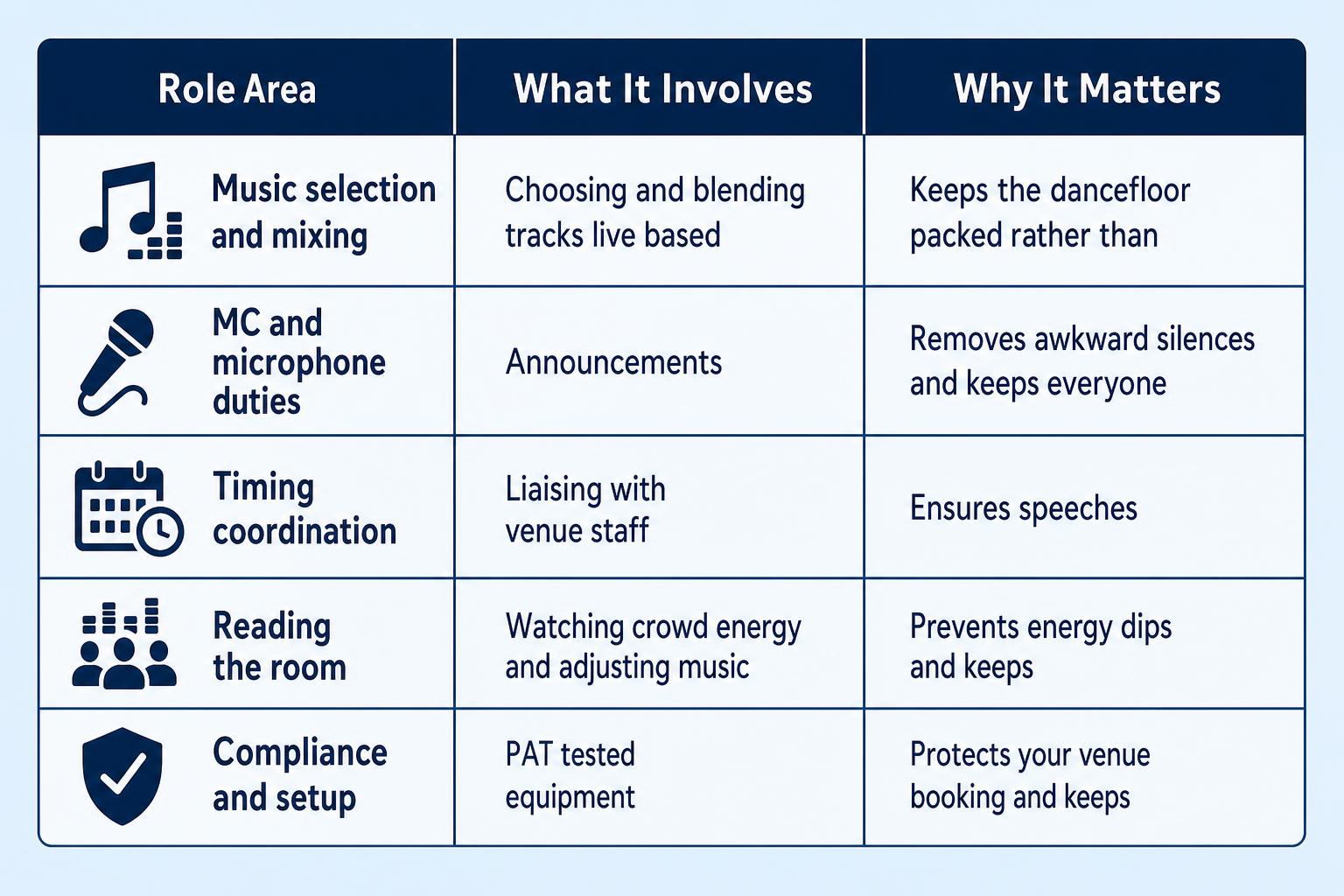
Here’s a snapshot of where the role typically sits across an evening, and why each part matters more than people expect.
| Role Area | What It Involves | Why It Matters |
|---|---|---|
| Music selection and mixing | Choosing and blending tracks live based on crowd response | Keeps the dancefloor packed rather than following a fixed, inflexible list |
| MC and microphone duties | Announcements, introductions, guiding guests through the running order | Removes awkward silences and keeps everyone informed |
| Timing coordination | Liaising with venue staff, caterers, photographers and toastmasters | Ensures speeches, food and key moments happen smoothly, on schedule |
| Reading the room | Watching crowd energy and adjusting music in real time | Prevents energy dips and keeps the party flowing naturally |
| Compliance and setup | PAT tested equipment, public liability insurance, sound limiters where required | Protects your venue booking and keeps things running legally and safely |
Coordinating Timings With Your Venue and Other Suppliers
A DJ who only thinks about their own booth is missing half the job. Behind the scenes, we’re liaising with venue coordinators, caterers, photographers and toastmasters to make sure everything lands at the right moment. Speeches need to happen once the room has settled, not while plates are still being cleared. Similarly, the first dance needs to follow naturally from the meal, not create an awkward lull while guests wait around.
This coordination often starts weeks before the event itself, through planning meetings and detailed timeline documents. On the day, it continues quietly in the background, with a DJ checking in with catering staff about food timings or confirming with a venue manager exactly when the room needs to be cleared for evening guests. Getting this right, well ahead of time, is why we always recommend working through a proper wedding timeline with your DJ long before the date arrives.
Meanwhile, venues themselves often have their own quirks. Some have strict curfews, others require access at a specific time for setup, and many have sound limiters that need factoring into the equipment plan in advance. A DJ who has worked a wide range of UK venues will already know what questions to ask, rather than discovering problems on the night.
It’s Not Just Weddings: Corporate and Private Events
Most articles on this topic focus entirely on weddings, but the same principles apply just as much to corporate functions, milestone birthdays, and private parties. A Christmas party for a company of 150 people needs the same read-the-room instinct as a wedding reception, just with a different crowd dynamic and often a tighter schedule.
Corporate bookings frequently involve working around a formal agenda, awards, presentations, or a specific finish time dictated by a venue contract. Private parties, meanwhile, might need more flexibility, with the DJ adapting quickly if the evening runs ahead of or behind schedule. Either way, the underlying job is identical: manage the music, manage the room, and manage the clock, all at once. If you’re planning something outside the traditional wedding format, our party and event DJ hire page covers how we approach these bookings specifically.
The UK Practicalities Nobody Talks About
Most of the DJ blogs ranking for this topic are American, and understandably, they skip over the practical realities of hiring a DJ in the UK. There’s more to it than most people realise.
PAT Testing and Public Liability Insurance
Any venue worth its salt will ask for proof of PAT tested equipment and current public liability insurance before allowing a DJ to set up. This isn’t box-ticking bureaucracy, it protects you, your guests and the venue itself. A professional DJ should be able to produce this documentation without hesitation. For the official position on inspection and testing frequency, it’s worth reading the gov.uk PAT testing guidance published by the HSE. We’ve covered exactly what to check for in our guide to PLI and PAT compliance for UK mobile DJs, which is worth a read if you want to know what questions to ask before booking anyone.
Noise Curfews and Venue Restrictions
Many UK venues, particularly rural barns, marquees and listed buildings, operate under strict noise curfews agreed with the local council. Some also require sound limiter compliance, which can affect the music at certain points in the evening. A DJ who regularly works these venues will know how to manage the sound levels without it feeling restrictive to your guests. This is exactly the kind of detail that gets missed when people assume any DJ can simply turn up and plug in.
What a DJ Doesn’t Do (Setting Realistic Expectations)
To be clear, a DJ isn’t a wedding planner, a venue coordinator, or a substitute for your toastmaster if you’ve booked one separately. Their role sits alongside these people, not in place of them. A good DJ communicates well with everyone else involved, rather than trying to run the whole show single-handedly. Knowing where those lines sit in advance avoids confusion on the day itself, which is one of the most common issues we cover in our article on the mistakes people make when hiring a DJ.
Frequently Asked Questions
Is a DJ the same as an MC at a wedding?
Not exactly, though at most UK weddings one person does both jobs. A DJ handles the music and mixing, while MC duties cover the microphone work, such as announcements and introductions. A skilled mobile DJ combines both roles seamlessly, which avoids the confusion of coordinating two separate people.
Do I need to give my DJ a full song list before the event?
A request list or “must play” list is genuinely useful, but it shouldn’t be a rigid script. A good DJ uses your preferences as a starting point, then reads the room on the night to decide the right order and timing for each track, keeping the dancefloor packed rather than following a fixed sequence regardless of the crowd’s energy.
Will my DJ liaise directly with my venue or caterer?
Yes, this is standard practice for any experienced mobile DJ. Coordinating timings with venue staff, caterers and photographers happens both before the event, through planning conversations, and on the day itself, to make sure speeches, food service and key moments like the first dance all land at the right time.
What happens if a DJ isn’t confident with the microphone?
This is one of the biggest, and most overlooked, differences between DJs. Confident MC work takes experience and genuine personality on the mic, not just technical mixing skill. When booking, it’s worth asking directly how they handle announcements, since a hesitant or awkward MC can create exactly the kind of dead air a good DJ is supposed to prevent.
Do DJs handle non-wedding events like corporate parties too?
Absolutely. Corporate functions, milestone birthdays and private parties all need the same core skills, reading the crowd, managing music flow and handling announcements, just adapted to a different setting and often a tighter running order dictated by the venue or company agenda.
Now that you know what’s really involved beyond just pressing play, the next step is simple. Get your instant online quote before your date is gone, and let us handle the music, the mic, and the timings, so you don’t have to.
Related articles

Get your DJ quote!
Customer Testimonials
Jules did a fantastic job at our friend’s birthday party. Jules accommodated all of our requests without any issues and was very prompt in communicating with us.
SAM E.Fantastic DJ, Lovely personality and got the whole wedding dancing. Took every care for bride and grooms needs and would 100% recommend. Thank you making our wedding night special.
JESSICA & ASHLEY W.Jules was absolutely fantastic, and very dedicated and played great music with all songs requested. I would recommend to anybody and thank you Jules for making our day amazing.
ALICE B.