

Keep Calm and DJ On: A Guide to PLI and PAT Compliance for UK Mobile DJs
When booking a mobile DJ, professionalism is about more than great music and impressive equipment. PLI and PAT for UK Mobile DJs: The Complete Compliance Guide explains why Public Liability Insurance and Portable Appliance Testing are essential parts of running a trusted DJ service. Discover what venues expect, what the law says, typical costs, and why proper compliance matters.
This guide goes further than the basics. We’ll cover what PLI and PAT actually mean in practice, what the law genuinely says (and doesn’t say), realistic costs, and what happens when a supplier turns up without the paperwork to prove it.
Whether you’re a couple planning a wedding, an event organiser booking entertainment, or a fellow DJ tightening up your own compliance, this is the honest, properly detailed version.
What Do PLI and PAT Actually Cover?
Public Liability Insurance (PLI) protects a DJ, and by extension the client and venue, if something goes wrong during an event. Picture a guest tripping over a speaker cable, a light fitting coming loose, or a piece of equipment causing an injury on the dance floor. If a claim follows, PLI is what stands behind the DJ rather than leaving them to cover compensation and legal costs out of their own pocket.
Portable Appliance Testing (PAT) is the process of checking that electrical equipment, from speakers and lighting rigs to laptops and extension leads, is safe to use. A DJ carries a lot of powered kit into venues, often plugging into someone else’s electrical supply, so proving that gear has been checked matters just as much as the insurance behind it.
Put simply, PLI protects people if things go wrong. PAT reduces the chances of things going wrong in the first place. Together, they’re the two documents almost every UK venue will ask to see before a DJ is allowed to set up.
Is PLI and PAT a Legal Requirement for Mobile DJs?
Here’s the honest truth, and it’s one a lot of articles gloss over: neither PLI nor PAT testing is technically mandated by UK law for a self-employed mobile DJ. That said, “not legally required” doesn’t mean “not expected”, and the framework behind PAT is worth understanding properly rather than dismissing as red tape.
PAT testing sits under the Electricity at Work Regulations 1989, which require that electrical equipment used at work be maintained in a condition that prevents danger. Crucially, the regulations don’t specify how often testing must happen or in what format. That’s where the HSE guidance document INDG236 and the IET Code of Practice for In-Service Inspection and Testing of Electrical Equipment (5th edition) come in. These are the recognised, non-statutory references duty-holders use to work out a sensible, risk-based testing interval for their own equipment, rather than relying on the old assumption that everything needs testing exactly once a year, which came from the now-outdated 4th edition of the Code of Practice.
As for PLI, there’s no statute forcing a self-employed DJ to hold it. However, venues set their own conditions of entry, and the overwhelming majority now require proof of cover before a supplier is allowed on site. In practice, that makes PLI and PAT a commercial necessity even though they aren’t a legal one.
Public Liability Insurance: How Much Cover Does a DJ Actually Need?
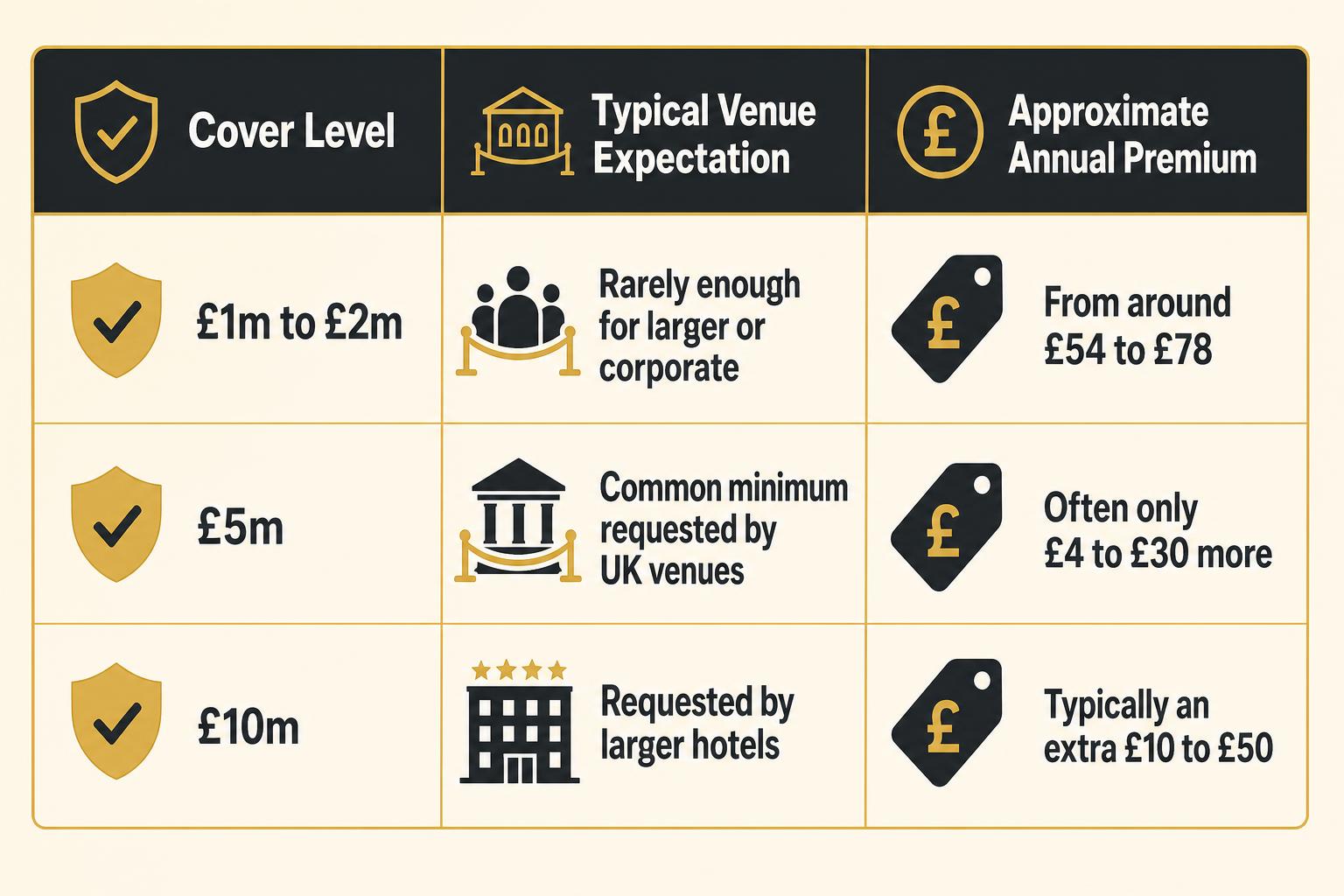
Cover levels are usually offered in set bands: £1 million, £2 million, £5 million and £10 million. Most UK venues ask for a minimum of £5 million, and it’s increasingly common for larger hotels, stately homes and corporate venues to ask for £10 million before they’ll confirm a booking. Since venue requirements vary so much, it’s always worth checking the specific figure a client’s venue expects rather than assuming any policy will do.
The table below gives a general sense of how cover levels and typical costs stack up.
| Cover Level | Typical Venue Expectation | Approximate Annual Premium |
|---|---|---|
| £1m to £2m | Rarely enough for larger or corporate venues | From around £54 to £78 |
| £5m | Common minimum requested by UK venues | Often only £4 to £30 more than £1m to £2m cover |
| £10m | Requested by larger hotels, stately homes and some corporate clients | Typically an extra £10 to £50 on top of £5m |
Interestingly, jumping from £1m up to £5m or even £10m often costs surprisingly little extra. Insurers price higher layers of cover cheaply because large claims are statistically rare, even though minor injury claims (think a twisted ankle from a trailing cable or a minor burn from stage lighting) are far more common and typically run somewhere between £5,000 and £20,000. That gap between a small extra premium and a potentially enormous claim is exactly why most working DJs simply buy the higher cover level and stop worrying about it.
Most policies also carry a standard excess, often around £500 per claim, so it’s worth checking that figure before assuming a policy covers every penny of a claim from pound one.
What About Employers’ Liability Insurance?
Employers’ Liability Insurance is a different product, and unlike PLI, it genuinely is a legal requirement in one specific circumstance: if a DJ employs staff, whether that’s a second DJ, an assistant, or dedicated lighting or sound crew. Adding employees to a policy can meaningfully increase the premium, so it’s worth factoring in early if a business is growing beyond a one-person operation rather than treating it as an afterthought.
PAT Testing: What a Certificate Actually Verifies
Not every PAT check is the same, and this is a distinction the current guidance on most DJ-facing pages skips entirely. There are two levels worth knowing:
- Formal visual inspection: a trained person checks equipment, plugs, and cables for visible damage, wear, or incorrect wiring, without using testing equipment.
- Combined inspection and testing: this adds electrical testing with a PAT tester, checking earth continuity, insulation resistance, and polarity, and is what most people actually mean when they talk about “getting kit PAT tested”.
A proper PAT certificate should confirm which of these was carried out, list the equipment tested by serial number or description, and state the date of the next recommended check. If a venue asks to see a PAT certificate, they’re really asking for evidence that this second, fuller process has happened, not just a quick visual glance over the kit.
How Often Should DJ Equipment Be Tested?
Because the Electricity at Work Regulations don’t set a fixed interval, the sensible approach is a risk-based one, following the IET Code of Practice rather than an arbitrary annual date. Equipment that travels to a different venue every weekend, gets packed and unpacked repeatedly, and gets plugged into unfamiliar sockets carries more risk than a laptop sitting on a desk in an office. As a result, most working DJs test annually as a practical, defensible interval, even though nothing in law demands exactly that frequency. What matters most is being able to show a consistent, sensible testing routine if a venue or client ever asks.
Risk Assessments and RAMS: The Document Venues Ask for Next
Increasingly, venues want more than PLI and PAT alone. A risk assessment, sometimes bundled with a method statement as “RAMS” (Risk Assessment and Method Statement), sets out how a DJ identifies hazards on site, from trailing cables and rigging points to fire exits and crowd flow, and how those risks are managed on the night. Larger venues, corporate events, and anywhere with a health and safety officer on staff are especially likely to ask for this alongside the usual certificates, so it’s worth having a template ready rather than scrambling to write one the week of the event.
What Happens If a DJ Turns Up Without the Paperwork?
This is the part couples and event organisers often underestimate. Venues can, and genuinely do, turn suppliers away or cancel a booking on the night if PLI and PAT documentation can’t be produced on request. That’s not a bureaucratic technicality, it’s a real risk to an event that’s taken months to plan. A venue’s own liability is on the line too, so staff are rarely willing to bend the rule for a supplier who can’t back up their claims with paperwork.
For anyone booking a DJ, this is exactly why it’s worth asking to see certificates before the big day rather than assuming they exist. It only takes one avoidable gap in the paperwork to turn a straightforward handover into a stressful last-minute scramble, and it’s one of several booking pitfalls covered in more depth in our guide to common mistakes people make when hiring a DJ.
Using PLI and PAT as a Trust and Pricing Tool
Here’s the angle a lot of DJs miss. Proper PLI and PAT compliance isn’t just box-ticking, it’s a genuine point of difference. Anyone can buy a pair of speakers and call themselves a DJ. Not everyone can produce a current insurance certificate and a PAT record going back years. That difference is exactly what separates a professional charging a fair, sustainable rate from an uninsured hobbyist undercutting on price.
Sharing certificates upfront, whether as downloadable PDFs on a website or simply emailed over once a booking enquiry comes in, builds trust before a client has even met the DJ in person. It answers the question before it’s asked, and it signals that the professionalism goes well beyond the playlist. It’s the same reasoning that underpins fair, transparent pricing across the industry, something we’ve written about in more detail in our guide to DJ hire costs in the UK.
Where to Get PLI and PAT Cover as a UK Mobile DJ
For DJs setting this up for the first time, or reviewing an existing policy, there are two broad routes:
- DJ associations such as NADJ (National Association of DJs), AMPdj, and Mobile DJ Network bundle around £10m of public liability cover into an annual membership, typically priced somewhere between £49.99 and £99. These often include added extras like discounted PAT testing, legal advice, or trade discounts.
- Standalone insurers, including names like NimbleFins, Simply Business, Protectivity, Suited, and Constructaquote, offer public liability policies built specifically for entertainers and mobile DJs, with quotes typically starting from around £54 to £78 a year for £1m to £2m of cover.
DJ Guard is another name that comes up frequently in the industry for entertainer-specific cover. Whichever route is chosen, the key is checking that the policy is genuinely designed for mobile entertainment work rather than a generic small business template that may exclude the kind of equipment and venue-based work a DJ actually does.
Other Cover Worth Knowing About
Once PLI and PAT are sorted, a few adjacent products are worth understanding too. Equipment or gear insurance covers the cost of replacing speakers, lighting, or decks if they’re stolen, damaged, or lost in transit, which is a real risk given how often a mobile DJ’s kit is loaded, unloaded, and set up in unfamiliar venues. Cancellation or postponement cover protects both the DJ and the client if an event can’t go ahead as planned, for reasons ranging from illness to venue closure. Neither is usually a legal requirement, but both are commonly bundled alongside PLI by insurers who understand the realities of mobile entertainment work.
Frequently Asked Questions
Is PLI and PAT a legal requirement for mobile DJs in the UK?
No, neither is technically mandated by law for a self-employed DJ. PAT sits under the Electricity at Work Regulations 1989, which require equipment to be maintained safely without specifying a testing frequency, while PLI is set as a condition of entry by individual venues rather than by statute.
How much public liability insurance does a DJ need?
Most UK venues ask for a minimum of £5 million, with some larger venues requesting £10 million. Cover is usually available in bands of £1m, £2m, £5m, and £10m, and moving up a band often costs only a small amount extra.
How often does DJ equipment need PAT testing?
There’s no legally fixed interval. Most working DJs follow the risk-based approach recommended in HSE guidance INDG236 and the IET Code of Practice, testing annually as a practical standard given how frequently their equipment travels and gets handled.
What happens if a DJ can’t provide PLI and PAT certificates?
Many venues will turn a supplier away or cancel their slot on the day if documentation can’t be produced, since the venue’s own liability is affected too. This is why it’s worth requesting certificates before booking rather than assuming they’re in place.
Where can I get PLI and PAT cover as a mobile DJ?
DJ associations like NADJ, AMPdj, and Mobile DJ Network bundle cover into an annual membership, while standalone insurers such as NimbleFins, Simply Business, Protectivity, Suited, and Constructaquote offer entertainer-specific policies directly.
The Bottom Line
PLI and PAT aren’t glamorous, and they’ll never be the reason a dance floor fills up. That said, they’re exactly what stands between a smoothly run event and a genuinely stressful situation if something goes wrong or a venue asks a question nobody can answer. We take compliance seriously for precisely that reason, so your booking stays protected from the first enquiry to the last song of the night.
Ready to book with a team that has all of this covered properly? Get your Instant Online Quote before your date is gone.
Related articles

Get your DJ quote!
Customer Testimonials
Jules did a fantastic job at our friend’s birthday party. Jules accommodated all of our requests without any issues and was very prompt in communicating with us.
SAM E.Fantastic DJ, Lovely personality and got the whole wedding dancing. Took every care for bride and grooms needs and would 100% recommend. Thank you making our wedding night special.
JESSICA & ASHLEY W.Jules was absolutely fantastic, and very dedicated and played great music with all songs requested. I would recommend to anybody and thank you Jules for making our day amazing.
ALICE B.