

Wedding Timeline UK: When to Do Your First Dance, Cake Cut and Party
Planning your wedding day involves hundreds of decisions, but getting the timing right is crucial. Our Wedding Timeline UK: When to Do Your First Dance, Cake Cut & Party guide answers the key questions couples ask, helping you plan a smooth, memorable celebration from day to evening.
Are you juggling a hundred small decisions at once? and few cause more head scratching than timing. Couples across the UK ask us the same question again and again: when should the first dance happen, when do we cut the cake, and when does the party actually start?
Nail your Wedding Timeline UK, and the whole day rolls forward without a single awkward pause. Get it wrong, however, and even a stunning venue can feel flat, with guests left standing around wondering what happens next.
This guide goes beyond the reception. We’ll walk you through the full day, from morning preparations right through to carriages, with realistic UK timing benchmarks for the ceremony, wedding breakfast, speeches, cake cutting, first dance and evening party. We’ll also cover the planning logistics, such as room turnarounds and DJ setup windows, that most generic timeline guides skip entirely.
Backward Planning: Building Your Timeline From a Locked Ceremony Time
Every solid wedding timeline starts in the same place: your ceremony time. Once that’s confirmed with your registrar, celebrant or venue, everything else gets built around it, working backwards through the morning and forwards into the evening. This is exactly how experienced planners and venue coordinators approach it, and it’s the method we’d recommend to any couple staring at a blank schedule.
For example, if your ceremony starts at 1:00pm, your hair and makeup team needs to finish two to three hours earlier, your photographer needs to arrive before you do, and your evening entertainment needs a rough idea of when the room will actually be ready for them. Work backward from the ceremony first, then forward from there, and the rest of the day tends to fall into place naturally.
A Sample Full-Day Wedding Timeline UK
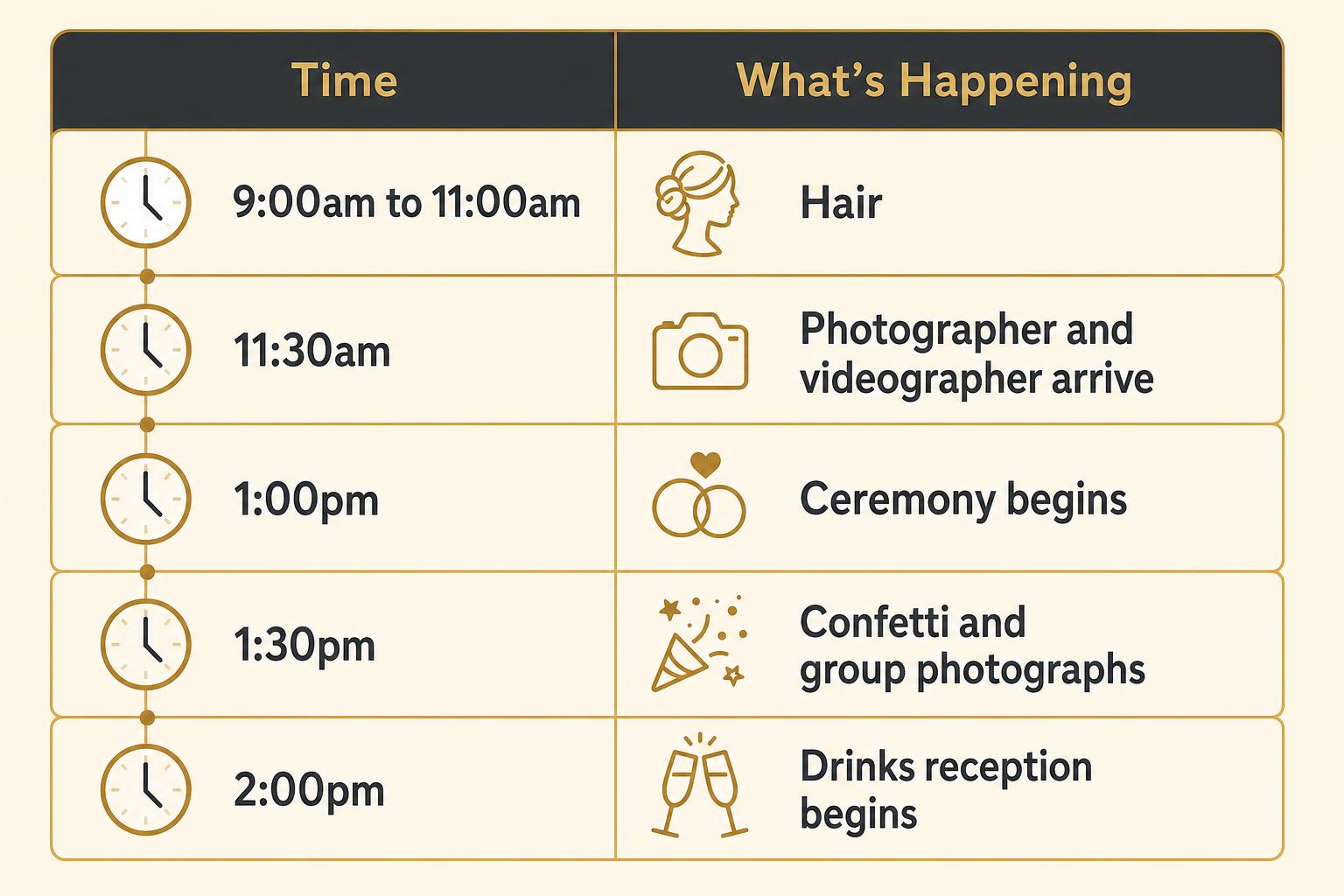
Here’s a realistic hour-by-hour structure based on a common 1:00pm civil ceremony. Treat it as a skeleton to adapt, not a rigid script.
| Time | What’s Happening |
|---|---|
| 9:00am to 11:00am | Hair, makeup and getting-ready photographs |
| 11:30am | Photographer and videographer arrive |
| 1:00pm | Ceremony begins |
| 1:30pm | Confetti and group photographs |
| 2:00pm | Drinks reception begins |
| 2:00pm to 4:00pm | Photos continue, canapes and mingling |
| 4:00pm | Wedding breakfast begins |
| 5:30pm | Speeches |
| 6:15pm | Room turnaround and DJ or band setup |
| 7:00pm to 7:30pm | Evening guests arrive |
| 8:45pm | Cake cutting |
| 9:00pm | First dance |
| 9:00pm onwards | Evening party begins |
| 9:00pm to 10:00pm | Evening food served |
| 11:45pm | Last dance |
| Midnight | Carriages and venue close |
Your actual times will shift depending on ceremony type, season, guest numbers and venue policy, but this gives you a genuine starting point rather than a blank page.
Ceremony Timing: Civil, Religious and Single Wedding Formats
Ceremony type dictates almost everything that follows, so it’s worth understanding the differences before you build the rest of your day.
How Long Different Ceremonies Take
Civil ceremonies and register office weddings typically run for thirty to forty five minutes, and most UK venues schedule them somewhere between 1:00pm and 3:00pm. Religious ceremonies tend to run longer, usually sixty to ninety minutes, which is why an 11:00am start is common when a church service is involved. Some couples instead choose a single wedding format, combining the ceremony and one meal into an evening event that starts around 5:00pm. For detailed information about UK marriage ceremony rules, you can check the official government guidance. Whichever route you take, ceremony length has a direct knock-on effect on when photos, drinks and the wedding breakfast can realistically begin.
If you’re planning music for the ceremony itself, such as the walk down the aisle or the moment you sign the register, getting those timings and song choices right matters just as much as the reception playlist. Our signing the register songs guide covers exactly how to time and choose that moment properly.
Daylight and Season Considerations
Season affects your timeline more than most couples expect. A winter wedding with a 3:00pm sunset needs the ceremony to start no later than 1:30pm if you want your confetti shot and group photographs in natural daylight. Summer weddings give you far more flexibility, and many couples now split their photography into two shorter sessions rather than one long one, catching golden hour light later in the evening instead of losing an hour of the drinks reception to a marathon photo call.
A small number of UK couples also borrow the American tradition of a “first look,” where the couple sees each other privately before the ceremony to get formal photographs out of the way early. It remains uncommon here, but it’s worth raising with your photographer if a long drinks reception isn’t appealing to you.
Wedding Breakfast vs Evening Reception: What’s the Difference
One phrase trips up almost every first-time wedding planner: the “wedding breakfast.” Despite the name, it isn’t breakfast at all. It’s the main sit-down meal of the day, usually served mid-afternoon after the ceremony and drinks reception. The evening reception is a separate phase entirely, often welcoming a fresh wave of guests who weren’t at the ceremony.
Keeping this distinction clear when you build your timeline helps you avoid confusing your caterer, your venue and your guests, all of whom will be working from the same schedule on the day.
Speeches: Order, Timing and a Genuinely Useful Alternative
Speeches traditionally follow the wedding breakfast, in a fixed running order: father of the bride first, then the groom, then the best man. Budget around ten minutes per speaker, or closer to five if you’ve got more than three people speaking, which brings a typical total to somewhere between thirty and forty five minutes. Build in a buffer regardless, because speeches almost always run over.
Some venues actually recommend flipping this structure and running speeches before the meal instead. It sounds unconventional, but it settles nerves early, lets the speakers relax and enjoy their food afterwards, and can tighten up the rest of your afternoon. It’s a nuance most wedding timeline guides skip, yet it’s worth raising with your venue coordinator if speech anxiety is a concern for anyone in your wedding party.
When Should You Cut the Cake?
Cake cutting is a quick moment, usually over within five to ten minutes, but it carries more weight than couples expect. It signals that the evening party is about to begin, and it’s your last real chance to have every guest gathered in one place before the dancefloor opens.
Best Time to Cut the Cake
Place cake cutting immediately before your first dance. Guests are already gathered for it, there’s no need to interrupt the dancefloor later to pull everyone back together, and it creates one continuous flow into the party rather than two separate, disconnected moments. Many wedding DJs will invite guests to gather round beforehand, turning it into a genuine highlight rather than a side event nobody notices.
When Should You Do Your First Dance?
The honest truth is that first dance timing varies more than a lot of generic advice suggests, because it depends heavily on when your ceremony started. On many UK timelines, especially where the ceremony began around 1:00pm, the first dance lands between 9:00pm and 9:30pm, roughly thirty minutes to an hour after evening guests arrive or the wedding breakfast wraps up. Where the day started earlier, or the meal finished sooner, some couples move it forward to as early as 7:30pm to 8:15pm instead.
Why the Later Slot Usually Works Best
- Evening guests have already arrived
- The room feels full and lively
- Guests are genuinely ready for the party
- It creates a natural transition into dancing
Pro tip: avoid rushing your first dance before evening guests have properly settled in. It can feel flat if the room’s still half empty. Talk to your wedding DJ about your specific ceremony time and guest numbers, since they’ll usually know what’s worked well at similar weddings nearby.
Evening Party, Evening Food and Last Orders
The party should start straight after your first dance, with no gap in between. Leaving a pause here is one of the most common and most avoidable mistakes we see.
The Perfect Flow
- First dance finishes
- DJ invites guests onto the dancefloor
- Music instantly lifts in energy
This is what creates a packed dancefloor from the very first song, rather than a slow trickle of guests wandering over ten minutes later.
Evening Food and Last Dance
Evening food, whether that’s a buffet, bacon rolls or a hog roast, typically lands somewhere between 9:00pm and 10:00pm, giving guests a natural pause partway through the party without killing momentum. Many UK venues wrap the night with a last dance around 11:45pm, with carriages and venue close following at midnight. If your timeline has a natural lull, for instance while the room is being turned around, build in thirty to forty five minutes of deliberate “chill out” buffer time rather than pretending it doesn’t exist. Guests appreciate an honest breather far more than a schedule that claims to run perfectly to the minute.
Room Turnaround and Your DJ’s Setup Window
Here’s something most generic wedding timeline guides miss entirely: the room your wedding breakfast happens in often isn’t the room your evening party happens in, and turning one into the other takes real time. Round tables need clearing, a dancefloor needs laying, and your entertainment needs access before a single evening guest arrives.
A DJ typically needs far less setup time than a live band, who may need up to an hour to set up and soundcheck properly. That said, treat your entertainment’s setup window as a fixed constraint on your timeline, not an afterthought. Some venues won’t allow access to the room until the wedding breakfast has fully cleared, which means your DJ or band is effectively working to the same clock as the catering team clearing plates.
We always recommend sharing your draft timeline with your venue coordinator and every supplier well in advance, not just your DJ. A shared schedule keeps your photographer, caterer, florist and entertainment all working from the same page on the day, and it removes the guesswork that causes hold-ups. Our guide on what a DJ actually does at an event goes into more detail on how a good DJ manages this handover with your other suppliers, not just the music.
Why Getting Your Timeline Right Matters More Than You Think
Your timeline controls the energy of your entire wedding day, how engaged your guests feel, and whether your dancefloor fills or falls flat. With the average UK wedding venue costing somewhere between £9,000 and £11,000, getting the running order right isn’t a minor detail. It’s what protects the investment you’ve already made in the day.
A well-planned timeline means no awkward gaps, no confused guests, and a natural build into a party that actually delivers on everything you’ve spent months planning.
Common Wedding Timeline Mistakes to Avoid
1. First Dance Too Early
Guests aren’t ready yet, and the moment falls flat before the room’s even settled.
2. Long Gaps Between Events
Every dead pause between moments kills momentum and lets energy drain away.
3. Cake Cutting Left Too Late
Cutting the cake once the dancefloor’s already busy interrupts the vibe you’ve just built.
4. No Clear Transition Into the Party
Without a defined handover, guests are left unsure what’s happening next, and unsure guests don’t dance.
5. Ignoring the Room Turnaround
Forgetting that the room needs clearing and resetting can leave your DJ or band scrambling, and your evening guests waiting outside a locked door.
Alternative Timeline Structures for Modern UK Weddings
Not every wedding follows tradition, and that’s genuinely fine.
First Dance Before the Meal
More intimate, with less pressure and fewer eyes watching, though it does trade away some of the evening atmosphere.
Late Night First Dance
Dramatic and unexpected, this works well for party-focused couples who want to build anticipation all evening.
Combined First Dance and Party Launch
Currently the most popular modern choice, and the best option for energy and flow, since there’s no gap for momentum to drop.
Expert DJ Tip: The Seamless Transition Trick
A professional wedding DJ won’t just play your first dance. They’ll engineer the moment.
- Fade or mix your first dance into a party anthem
- Invite guests onto the floor at exactly the right moment
- Build instant energy rather than letting it trickle in
This is what turns a quiet start into a full dancefloor within seconds, instead of five awkward minutes of guests glancing at each other.
How to Build Your Own Wedding Timeline UK
- Lock your ceremony time first, then plan backward and forward from it
- Group your key moments together to avoid long dead spells
- Factor in the room turnaround and your entertainment’s setup window
- Build in a genuine buffer for speeches and photographs
- Share the draft with your venue coordinator and every supplier in advance
Most importantly, work with your DJ and venue coordinator. They’ve seen dozens of these days run smoothly, and just as many run into trouble, so their input is worth far more than guesswork. If you are booking through us then you get your own dedicated Wedding DJ Client Portal for planning music and all aspects of your day.
Frequently Asked Questions
What time should evening guests arrive at a UK wedding?
Most UK weddings welcome evening guests between 7:00pm and 7:30pm, with some venues stretching that to 8:00pm depending on how long the wedding breakfast and speeches run.
How long should wedding speeches take?
Budget around ten minutes per speaker, or five minutes each if you have several people speaking, bringing most speeches to a total of thirty to forty five minutes. Add a buffer, because speeches almost always overrun.
What time is the first dance at most UK weddings?
The first dance commonly falls between 9:00pm and 9:30pm, roughly thirty minutes to an hour after evening guests arrive. Some couples with an earlier ceremony move it forward to between 7:30pm and 8:15pm instead.
Should the cake be cut before or after the first dance?
Cut the cake immediately before your first dance. Guests are already gathered together, and it creates one smooth transition into the evening party rather than two separate interruptions.
How much setup time does a wedding DJ need compared to a band?
A DJ typically needs considerably less setup time than a live band, which can require up to an hour to set up and soundcheck. Either way, treat your entertainment’s setup window as a fixed part of your timeline, since some venues won’t allow access to the room until it’s been fully cleared.
What is the difference between the wedding breakfast and the evening reception?
The wedding breakfast is the main sit-down meal, usually served in the afternoon after the ceremony and drinks reception, not literal breakfast food. The evening reception is a separate later phase, often with new guests joining for the party.
Final Thoughts
Your wedding timeline isn’t just a schedule. It’s the backbone of your entire day.
Get the timing right, and everything feels effortless: your first dance feels magical, your cake cutting feels natural, and your party starts strong and stays full until carriages. There’s no single “perfect” timeline, but there is a perfect flow, and now you’ve got the framework to build yours.
If you haven’t yet booked a wedding DJ, read our guide on hiring the perfect DJ, along with our article on the 10 mistakes people make when hiring a DJ. Both are genuinely useful reading while you finalise your plans.
Planning the timing of your wedding day is much easier when everything is organised in one place. That’s why we give every couple access to our dedicated client portal, where you can create your own wedding timeline using a simple drag-and-drop planner.
With our client portal you can also build your perfect soundtrack with integrated Deezer/Spotify/Apple music song search, making it quick and easy to choose your must-play songs for key moments such as your entrance, first dance, cake cutting, and evening party. It helps ensure your day runs smoothly while giving your DJ all the information needed to keep everything on track.
If you want your wedding to run smoothly with a dancefloor that’s packed all night, working with an experienced wedding DJ makes all the difference, from timing advice through to reading the room once the party starts.
Why not get your Instant Online Quote today, check availability for your date, and put your timeline questions to a DJ who’s genuinely seen it all before?
Related articles
- How to Avoid an Empty Dance Floor at Your Wedding: 7 DJ Icebreaker Tricks
- The Best Wedding First Dance Songs UK List: Romantic, Modern & Timeless Ideas (2026)

Get your DJ quote!
Customer Testimonials
Jules did a fantastic job at our friend’s birthday party. Jules accommodated all of our requests without any issues and was very prompt in communicating with us.
SAM E.Fantastic DJ, Lovely personality and got the whole wedding dancing. Took every care for bride and grooms needs and would 100% recommend. Thank you making our wedding night special.
JESSICA & ASHLEY W.Jules was absolutely fantastic, and very dedicated and played great music with all songs requested. I would recommend to anybody and thank you Jules for making our day amazing.
ALICE B.